
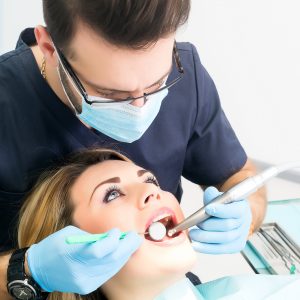
 To perform the crown procedure, your dentist prepares the tooth and makes a molded impression or a digital scan of your teeth to send to a dental laboratory. A custom-made temporary crown is created during this visit to protect the tooth while the final restoration is being made in the dental laboratory. Once completed, the crown will be cemented or adhesively bonded at a second visit.
A recent technology, CAD/CAM technology (computer-aided design/manufacturing technology) has evolved to display a 3-D picture of the teeth. A restoration is then created through milling of a ceramic block.
After your new crown has been placed, your dentist will provide you with information about caring for your new restoration. In general, maintain proper oral hygiene habits by brushing twice daily and flossing with dental floss or interdental cleaners (specially designed brushes and sticks) once a day. These practices will help to remove plaque from the area where the crown meets the gum, and help prevent dental decay and gum disease.
Avoid chewing hard foods, ice or other hard objects, since this could damage your crown. It also is important to avoid biting your fingernails and grinding your teeth, which could significantly shorten its life-span. If you habitually clench or grind your teeth, your dentist may recommend wearing a night-time mouth guard to offer protection while sleeping.
If you, your family or friends need dental care, we would be honored to provide you with state-of-the-art dental care in our modern dental practice. Refer someone you love to someone you trust!
Presented as a service to the community by Doctors Hoover and Yanda,
39 Milford Drive, Hudson, Ohio 44236. 330-650-0360. www.drshooverandyanda.com
 Composite fillings are usually more expensive than traditional amalgam fillings because they require a more sophisticated process, more expensive materials and additional office equipment. Composite materials offer an aesthetic alternative to traditional amalgam materials. Because composites can be bonded to teeth, they provide a better seal against leakage and further decay. As such, people who have previously received amalgam fillings often return to their dentist to have them replaced with composite.
 Our mouths are full of bacteria. Hundreds of different types live on our teeth, gums, tongue and other places in our mouths. Some bacteria are helpful. But some can be harmful, like those that play a role in the tooth decay process. Tooth decay is the result of an infection with certain types of bacteria that use sugars in food to make acids. Over time, these acids can create a cavity in the tooth.
 People usually don’t show signs of gum disease until they are in their 30s or 40s. Men are more likely to have gum disease than women. Although teenagers rarely develop periodontitis, they can develop gingivitis, the milder form of gum disease. Most commonly, gum disease develops when plaque is allowed to build up along and under the gum line.