
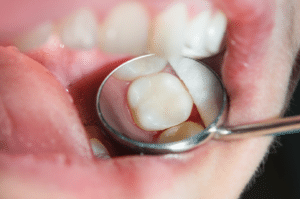
 Professionally, there are four main ways to deal with dental caries. These treatments, carried out by a dental professional, can help treat damage incurred from dental caries.
Fillings
Fillings are the most common form of treatment for the disease. A dental professional drills into the affected area(s) of the teeth, removes the decayed material inside the prepared cavity, and packs this empty space with an appropriate dental filling material. There are different types of filling materials that can be used, depending on the area where caries has occurred. Composite resin, the most common filling material in the developed world, has a great pallet of color which dentists can use to repair caries damage to teeth that are visible when you smile. In the case of back teeth, some dentists prefer using other dental filling materials which are stronger.
Crowns
Crowns are another option for dental professionals when treating dental caries, and are used when a large proportion of the tooth is destroyed by disease. When tooth decay leads to the need for large fillings, the tooth becomes more prone to cracks and ultimately breaking. The dentist would attempt to salvage the remaining tooth, repair it, and finally fit the tooth with a crown covering.
If you, your family or friends need dental care, we would be honored to provide you with state-of-the-art dental care in our modern dental practice. Refer someone you love to someone you trust!
Presented as a service to the community by Doctors Hoover and Yanda,
39 Milford Drive, Hudson, Ohio 44236. 330-650-0360. www.drshooverandyanda.com


 The Food and Drug Administration recommends that parents and caregivers not use benzocaine products for children younger than age 2. Benzocaine is an over-the-counter anesthetic, which the FDA notes is marketed under the product names Anbesol, Hurricaine, Orajel, Baby Orajel and Orabase. Benzocaine has been associated with a rare but serious—and sometimes fatal—condition called methemoglobinemia, a disorder in which the amount of oxygen carried through the bloodstream is greatly reduced.
 Teeth grinding, also called bruxism, can be caused not just by stress and anxiety but by sleep disorders, an abnormal bite or teeth that are missing or crooked. People who drink alcohol and smokers are approximately twice as likely to grind their teeth. The symptoms of teeth grinding include dull headaches, jaw soreness, teeth that are painful or loose, and fractured teeth.
 Sparkling water is far better for your teeth than sugary drinks. In addition, be sure to drink plenty of regular, fluoridated water, too—it’s the best beverage for your teeth. Water with fluoride naturally helps fight cavities, washes away the leftover food cavity-causing bacteria feast on and keeps your mouth from becoming dry (which can put you at a higher risk for cavities).
 When You’re Working Out
 When You Need Something to Drink