
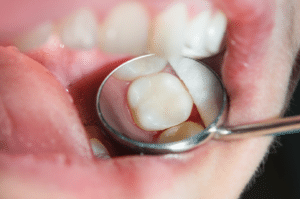
 Professionally, there are four main ways to deal with dental caries. These treatments, carried out by a dental professional, can help treat damage incurred from dental caries.
Fillings
Fillings are the most common form of treatment for the disease. A dental professional drills into the affected area(s) of the teeth, removes the decayed material inside the prepared cavity, and packs this empty space with an appropriate dental filling material. There are different types of filling materials that can be used, depending on the area where caries has occurred. Composite resin, the most common filling material in the developed world, has a great pallet of color which dentists can use to repair caries damage to teeth that are visible when you smile. In the case of back teeth, some dentists prefer using other dental filling materials which are stronger.
Crowns
Crowns are another option for dental professionals when treating dental caries, and are used when a large proportion of the tooth is destroyed by disease. When tooth decay leads to the need for large fillings, the tooth becomes more prone to cracks and ultimately breaking. The dentist would attempt to salvage the remaining tooth, repair it, and finally fit the tooth with a crown covering.
If you, your family or friends need dental care, we would be honored to provide you with state-of-the-art dental care in our modern dental practice. Refer someone you love to someone you trust!
Presented as a service to the community by Doctors Hoover and Yanda,
39 Milford Drive, Hudson, Ohio 44236. 330-650-0360. www.drshooverandyanda.com
 of mouthguards: the “boil and bite” type and the custom-made type. The “boil and bite” mouthguard is fitted by the athlete him or herself by dipping it into boiling water for a couple of minutes, and then forming it to the teeth while it is soft and moldable. This is the less costly type, can be re-molded by reboiling it if need be and for many people it works fine. Some people require a more precise fit than a “boil and bite” mouthguard can provide. For them, their dentist can make a custom-made mouthguard. The dentist makes impressions of the teeth and a laboratory-processed mouthguard is then fabricated. It fits much more comfortably because of the custom-fit.
 Clinical studies have shown that chewing sugarless gum for 20 minutes following meals can help prevent tooth decay.
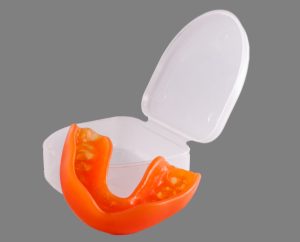 ment: Talk to your dentist about when is the right time to replace your mouthguard, but replace it immediately if it shows sign of wear, is damaged or ill-fitting. Teens and children may need to replace their mouthguards more often because their mouths are still growing and changing. Between games, it’s important to keep your mouthguard clean and dry. Here are some tips for making sure your mouthguard is always ready to go:
 Mouthguards help cushion a blow to the face, minimizing the risk of broken teeth and injuries to your lips, tongue, face or jaw. They typically cover the upper teeth and are a great way to protect the soft tissues of your tongue, lips and cheek lining. Your top teeth take the brunt of trauma because they stick out more. Your bottom teeth are a little more protected because they are further back.
 cerebral small-vessel disease that can lead to a stroke.
 brushing techniques, the importance of limiting sugary drinks, and the need to avoid putting children to bed with a bottle.