With Halloween comes ghosts, goblins, and goodies—and the sugar in those treats can play some unwanted tricks on your teeth if you’re not careful.
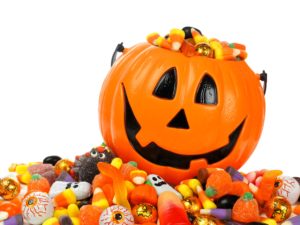
Here’s why: the bacteria in your mouth are probably more excited to eat Halloween candy than you are. When the bacteria eat the sugar and leftover food in your mouth, an acid is produced. That acid is what causes cavities.
It’s OK to eat candy on Halloween as a splurge as long as you’re brushing twice a day and flossing once a day all year long.
To help you sort through the trick-or-treat bag loot, we have a rundown of some common candies and their impact on your teeth:
Chocolate
Chocolate is probably your best bet, which is good because it’s also one of the most popular kinds of candy handed out on Halloween. Chocolate is one of the better candies because it washes off your teeth easier than other types of candy. Dark chocolate also contains less sugar than milk chocolate.
If you, your family or friends need dental care, we would be honored to provide you with state-of-the-art dental care in our modern dental practice. Refer someone you love to someone you trust!
Presented as a service to the community by Doctors Hoover and Yanda,
39 Milford Drive, Hudson, Ohio 44236. 330-650-0360. www.drshooverandyanda.com


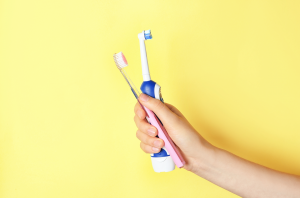 . Cleaning your toothbrush is easy: Rinse it with tap water to remove any remaining toothpaste and debris. Store it upright and allow it to air dry. If you store your toothbrush with other toothbrushes, make sure they are separated to prevent cross-contamination. And do not routinely cover toothbrushes or store them in closed containers. A moist environment such as a closed container is more conducive to the growth of unwanted bacteria than the open air.
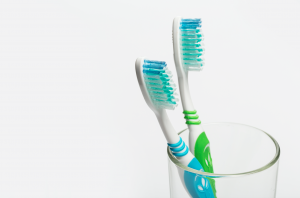 We know and love our toothbrushes as the tools that kick plaque to the curb, help keep cavities at bay (with the help of fluoride toothpaste, of course) and freshen our breath. But what else can we learn about them? Read on for some toothbrush facts.
 The Food and Drug Administration recommends that parents and caregivers not use benzocaine products for children younger than age 2. Benzocaine is an over-the-counter anesthetic, which the FDA notes is marketed under the product names Anbesol, Hurricaine, Orajel, Baby Orajel and Orabase. Benzocaine has been associated with a rare but serious—and sometimes fatal—condition called methemoglobinemia, a disorder in which the amount of oxygen carried through the bloodstream is greatly reduced.
 While we certainly have many patients who have traditional dental insurance plans, there is a new method of paying for dental services that is becoming a very popular. A Concierge Plan is an in-office plan that helps patients afford their needed dentistry. It is not traditional dental insurance, but rather a “membership plan,” very similar to plans like Costco, Amazon Prime, Sam’s Club, etc. For one very affordable annual fee, a patient in our office receives a comprehensive exam for new patients, two professional cleanings and two periodic exams per year, an emergency exam if needed, a full-mouth series of x-rays every five years, one set of bitewing x-rays per year, two fluoride treatments per year if needed and 15% off of any other dental treatment they have done within that year. There is no limit on how much dentistry can be received. We have other plans too for families and for periodontal patients who need more frequent cleanings.
  Teeth grinding, also called bruxism, can be caused not just by stress and anxiety but by sleep disorders, an abnormal bite or teeth that are missing or crooked. People who drink alcohol and smokers are approximately twice as likely to grind their teeth. The symptoms of teeth grinding include dull headaches, jaw soreness, teeth that are painful or loose, and fractured teeth.